|
Hiking the Dandenong Ranges
One of our first outings after purchasing our car 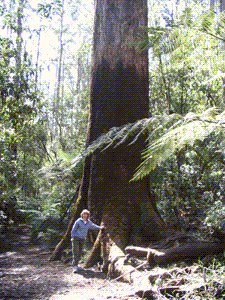 was a trip to the Dandenong mountain range east of central Melbourne. These are not really mountains as the elevations is barely 700 meters. Nevertheless, they are beautiful and an active recreational site for work-weary Melbournians. was a trip to the Dandenong mountain range east of central Melbourne. These are not really mountains as the elevations is barely 700 meters. Nevertheless, they are beautiful and an active recreational site for work-weary Melbournians.
As you can see from the picture on the right, this forest grows some rather impressive trees. This beauty is a Mountain Ash, a member of the eucalypt family and is known as the largest flowering tree in the universe, or at least the world. It grows to a maximum of 50 meters high and covers much of the forests in eastern Victoria.
We were looking to get out and enjoy the natural structure that we could see in the distance from the city, but were unable to explore until we secured a means of transportation. This came in the form of a Ford Falcon purchased from one of Keith's neighbors. The car burns both unleaded gas (known here as unleaded petrol, ULP) and propane gas (called car gas or LPG) by the mere flick of a switch on the dashboard. LPG is about one third the cost of ULP and is about one third less efficient, mileage wise.
The ranges are about a forty minute drive from our townhouse over mostly four lane highways. There are many organized trails to hike in these ranges and we, more or less, chose one of the trails to hike based on its name. We were interested in coming across the Lyrebird that is reputed to have a beautiful tail feather array and a voice to match it.
"The Superb Lyrebird is its most famous inhabitant. People the world over are fascinated by the ability of this bird to mimic the calls of other bird species, and by the dancing display and beautiful tail of the male. Sulphur-crested Cockatoos, Crimson Rosellas, Laughing Kookaburras, Eastern Yellow Robins, Yellow-faced Honeyeaters and Pied Currawongs are some of the native birds most frequently seen in the park."(1)
So it was the Lyrebird trail for us. We parked on the upper portion of the trail and walked downward into the thick of the forest. We did not encounter anyone at first, so we enjoyed having the trail to ourselves. There was plenty to see. Ferns seem to dominate the understory, and we could hear the occasional bird high up in the trees. As the trail leveled off, we started to meet other hikers who had come from the other end of this trail. We finally emerged from the forest trail onto a "car park" as parking lots are called here. This area was a ranger station with a coffee shop for tourists. This is where the other hikers were coming from. We read the signs, watched the birds and generally enjoyed the rest. After a suitable pause, we retraced our steps back up the hill to the car.
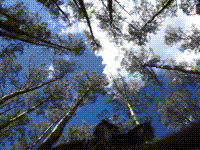 The forest is quite different from any we have encountered before. The preponderance of eucalypt trees gives the forest, above all, a unique smell; their height gives you a cathedral-like feeling as seen in the picture to the left. Many of the trees are scarred from night-time feeding by Gilders and Goannas, birds indigenous to this type of forest. The other major species is called a fern tree and is pictured on the right. The forest is quite different from any we have encountered before. The preponderance of eucalypt trees gives the forest, above all, a unique smell; their height gives you a cathedral-like feeling as seen in the picture to the left. Many of the trees are scarred from night-time feeding by Gilders and Goannas, birds indigenous to this type of forest. The other major species is called a fern tree and is pictured on the right.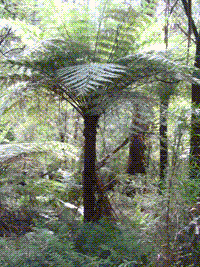 Of course, there is a host of other plant species, but I wouldn't know about that. I am told that they are common to cool temperate rainforest conditions that are characteristic of this region of Australia. One other reported characteristic of the eucalypt forest is the blue tinge seen in the air around the mountains from a large distance away. Of course, there is a host of other plant species, but I wouldn't know about that. I am told that they are common to cool temperate rainforest conditions that are characteristic of this region of Australia. One other reported characteristic of the eucalypt forest is the blue tinge seen in the air around the mountains from a large distance away.
Fire plays an important role in the ecology of the vegetation in these ranges and is an on-going issue for its residents. We see plenty of television commercials informing bush residents of the need for an evacuation plan. As the copy goes: "bush fires are a part of Australian life." On the other hand "controlled burns" are used regularly to promote biodiveristy by stimulating dormant seeds that would not develop if the brush cover were not occasionally destroyed. We were just as happy not to be exposed to the ravage of a bush fire during our visit to the Dandenongs.
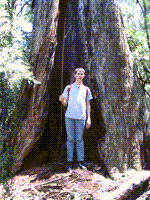 We liked our hiking experience so much that we returned when Ari and Dan came to visit at Christmas, as witnessed by the photo here on the left. We could not resist putting Dan in one of the tree shots. We liked our hiking experience so much that we returned when Ari and Dan came to visit at Christmas, as witnessed by the photo here on the left. We could not resist putting Dan in one of the tree shots.
I haven't mentioned anything about some of the birds that we encountered. Sadly, we did not observ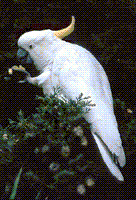 e the Lyrebird, but we did see a Sulfur Crested Cockatoo, the Crimson Rosella and plenty of Lorikeets. The Lorikeet is a particularly pretty bird and one that I can often see feeding just outside my office window on a nice day. They don't seem to be particularly noisy, but I would not swear to that. e the Lyrebird, but we did see a Sulfur Crested Cockatoo, the Crimson Rosella and plenty of Lorikeets. The Lorikeet is a particularly pretty bird and one that I can often see feeding just outside my office window on a nice day. They don't seem to be particularly noisy, but I would not swear to that.
All of these birds tend to be friendly, so much so that the park management has erected signs which try to discourage visitors from feeding them (the birds, that is). The birds are so tame that 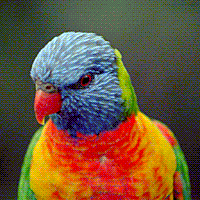 they will land on your shoulder and eat from your hand. The posted signs suggest that contact with the birds is a health hazard and should be avoided. They also mention that the birds will become dependent on humans and lose their foraging skills if fed by little Johnie or Sally. The signage effort did not have much impact, or, perhaps, Australians just can't read. they will land on your shoulder and eat from your hand. The posted signs suggest that contact with the birds is a health hazard and should be avoided. They also mention that the birds will become dependent on humans and lose their foraging skills if fed by little Johnie or Sally. The signage effort did not have much impact, or, perhaps, Australians just can't read.
So I expect we will be paying visits often to this forest. Perhaps, we will be lucky and finally come across the Lyrebird. Stay tuned.
|
|
